The best explanation and value of beats in your work in progress that I've read
Beat Sheets: For Plotters, Pantsers, and Technophobes
The best explanation and value of beats in your work in progress that I've read

Jacquie Biggar-USA Today Best-selling author
Read. Write. Love. 💕💕💕
The best explanation and value of beats in your work in progress that I've read
The sounds of birds singing and the cheerful conversations of my neighbours out enjoying the sunshine heralded the passing of the long winter season. Some, such as my six year old grandson, will miss it for all the great winter sports such as hockey, skiing, snowboarding, sledding, and skating. As for myself, this was my …
 This GORGEOUS image via Flickr Creative Commons, courtesy of Aimannesse Photography
Fear is a funny thing. We all experience it. Fear can be positive. It can keep us out of danger. It can stop us from making a super dumb decision, like getting in a car with a driver who’s been drinking too much. Fear can drive us to change for the better. At the same time, fear can cripple and, in extreme cases, can be deadly (I.e. suicide). Fear kills more dreams than failure ever has.
Fear is something we have to understand and respect. It’s a feeling and feelings do lie. Are feelings useful? Of course. But they can be affected by so many outside influences we are foolish to solely rely on them for guidance. Feelings can be affected by weather, diet, lack of exercise, a flat tire, a pile of unopened mail, stress, and on and on…
View original post 2,316 more words
Jennifer Crusie's Blog: Argh Ink | Questionable: Romantic Conflict.
Jennifer Crusie's Blog: Argh Ink | Questionable: Pictures and Writing.
 How does a literary agent define their “ideal client”? The question is extremely important because it’s one that factors into an agent’s mindset before and after they sign you.
If an agent has read your complete novel or book proposal and wants to sign you, the next step is almost always to arrange a telephone call where the two of you get to know one another. You ask the questions you want to ask about her and her style; she does the same regarding you and your style. During the phone conversation, the agent is trying to gauge whether you’re compatible enough with her to be signed as a new author in her stable. She’s already sizing up whether you can be a good, long-term client, or close to it.
Then after you sign with the agent, the two of you begin a long process of working…
View original post 992 more words
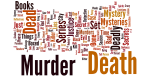 BookBub’s mystery word cloud
Most of us on this blog haven’t thought too much as yet about what we’ll name our books when they’re finished. In class, we talked about the burden a title must bear—a good one should suggest genre, theme, tone, maybe even setting and character. Getting it right is difficult.
The words used in book titles have trends, according to BookBub, an ebook promotion services company. Using data from the last six months, BookBub analyzed 3,850 books to see which words turn up most frequently in titles. BookBub looked at multiple fiction categories, including mysteries, thrillers, women’s fiction, historical fiction, action and adventure, horror, contemporary romance, historical romance, children’s and middle grade, and religious and inspirational, and built word clouds to show the results. Which word was used the most often across all categories?
View original post 467 more words
 I’m guilty of ending sentences with prepositions. I sometimes use “hopefully” wrong. Maybe I say, “I feel bad” instead of “I feel badly.” Even worse, just recently, I said “absolutely” in an interview (an overused answer, though absolutely viable–just a pet peeve). But here, I will give just a few pet peeves I’ve encountered in the last week–things that made me go grrrrr:
I’dof instead of I’d have. Example: I’d of thought he’d buy me that ice cream. How lazy is that? I know the brain doesn’t always coordinate with the fingers. They type what they sense from those crafty synapses, but this one frightens me. It sounds right!
Nonplussed means confused, not indifferent. Grrrr. She was so nonplussed when Justin Bieber knocked on her door (I’d be indifferent–and confused).
Aspiration vs. inspiration. Zac Effron–though I loved him–mixed up these two at the Oscars. As he said the…
View original post 111 more words
 By Shannon Donnelly
Great dialogue can make or break a novel.
This view may stem from growing up watching a lot of 1930’s screwball comedies. Zingers fly with rapid fire and everyone talks. A lot. But the importance of dialogue really sank in when I wrote A Proper Mistress. I went for a lot of dialogue in that book and it went on to be one of my best selling romances.
We all know great dialogue when we read it—and the best dialogue seems effortless. But good dialogue takes work, sometimes needing multiple edits and thinking it over and totally revising a scene. It also takes a few key ingredients.
1) Give Your Characters Unique Voices.
Can you tell who is talking without any tags to make this obvious?
You have to get your characters talking in order to find their voices. And each character needs a distinct voice.
That…
View original post 1,071 more words
great advice 🙂
 This post is a tad late as I’ve had an oversubscribed weekend, first hosting a workshop at the London Author Fair and then teaching at the
Guardian
selfpublishing masterclass. In all that whirl I’ve met a lot of writers and would-be selfpublishers and thought I’d share some of the advice I gave most frequently.
This post is a tad late as I’ve had an oversubscribed weekend, first hosting a workshop at the London Author Fair and then teaching at the
Guardian
selfpublishing masterclass. In all that whirl I’ve met a lot of writers and would-be selfpublishers and thought I’d share some of the advice I gave most frequently.
1 Whether you intend to go indie or not, learn about selfpublishing
– then you’ll know how to weigh up the value of a publishing deal. As well as the money (which usually won’t cover the time you spent writing), a publisher offers editorial guidance, copy editing and proof reading, cover design as appropriate for the audience, print book preparation, publicity using their contacts and reputation, print distribution.
As I’ve said in this blog post, all of that is services that indie authors do for themselves. Some (not all) are easy to source and manage…
View original post 594 more words
Check it Out. Worked on my author page for a while today, come and check it out. 🙂


 Jacquie Biggar-USA Today Best-selling author